Welcoming the New Year

Welcoming the New Year and looking back on others

These were some of the friends he thought about while he was in the hospital.

Each year as we say good bye to the old year, we leave it behind with some regrets, promising ourselves we will live up to our resolutions and expectations that we have for the new year. 

In 1964, as the new year came to fruition, I wondered what it would bring for me and for my husband. In fact I wondered if he would live for another year. We had had so many plans for our life and now all of those dreams were shattered. He had been in a tragic accident and lay in the ICU unit of the Harrisburg hospital swathed in bandages and full of tubes. His one wish was to return to Alaska and to the people that he knew and loved when we were there. This is probably what sustained him during this time. His wish was granted and we returned to the small island of Kivalina, where we had lived for seven months. We were welcomed back by the whole village and although it was mid-May by then we felt as though our new year had finally begun. The snow was waist deep and the sea ice was still frozen. It was winter all over again and a new beginning for both of us. See my memoir to read more about this (Journey Through Fire and Ice) to be published by the end of January.

Cover of memoir

I think back to so many happy times I had over the years. In Winnipeg, there was always some sort of party and at midnight we would all sing Auld Lang Syne.So many years later, I remember one friend who would go up to a bedroom where all the coats were piled up toavoid the ritual of midnight kissing.

When we moved to Harrisburg, we would leave for our home in Canada the day after Christmas. There was always snow and the week before New Year’s Eve, we would enjoy wonderful times with our friends and families.As families, we all cross country skiied together and went tobogganing. There would be an outdoor picnic at our beach, New Year’s Eve shenanigans with charades, games and sometimes fireworks. The games were followed by a roast beef dinner and toasts to welcome the New Year. New Year”s Day often included a lunch and then we all said our good byes and waited till the summer when we would all be together again. As our children driftted off to university, these times ended.

Last year, my significant other and I went to Oil City, ate in a great restaurant and watched the fireworks there. Other years, we have watched the ball drop at Strawberry Square and joined the masses to watch the fireworks. But as we grow older, many of us find that staying up to greet the New Year is something we don’t have to do anymore.

This past year has been one we will never forget. In March most of us went into social isolation, having food delivered and not leaving our homes unless it was absolutely necessary. We hoped life would return to normal but after a few months most of us realized that was not going to happen. We wore masks, participated in zoom meetings and saw very little of friends or families. Thanksgiving and Christmas came and went and many of us celebrated without a large gathering.

 Life is still  not back to normal but with the promise of a new vaccine and the hope that many of us will be vaccinated soon, we all see a ray of light at the end of the very dark tunnel of the past year. Some of us have lost friends or family to this deadly virus and to those people who have lost loved ones during this time I am sending you an old Eskimo proverb that might comfort you at this time. It is one that I often think of when I gaze at the stars and think of those who have gone before me. To me it is a consoling thought. 

Having lived with the Eskimos (Inuits) in 1964/65 and again in 1969/70 it is a proverb I never heard, but one I will always love.
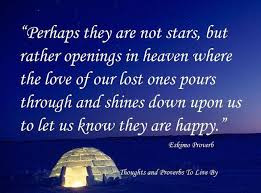
Eskimo Proverb

As I look forward to 2021, I hope it will be a year of peace for our country and a year when covid 19 is finally eradicated. What more could we hope for? A toast to you all for a healthy and happy new year.

Christmases Past and Present

Celebrating Christmas

Tiger and Karen with Sarah peeking out. Kotzebue 1969

      This week we will probably set up our tree. As a child, I remember decorating our tree with tinsel. We didn’t throw it on but placed it carefully on each branch. When we took the tree down we would take off the tinsel, wind it around  the cardboard and use it again the following year. The ritual continued with my children. 

Annual crystal ornament

      Now, my partner, John and I have replaced the tinsel with glass icicles which catch the light and glitter on the tree. I will put on the crystal snowflakes and stars collected for so many years. The only year missing is the year my husband died.  Tiny Tim is part of the tree, a reminder of the Dickens dinners that we celebrated with friends for so many years. The paper mache figure of Friar Tuck will be brought out and placed in the hall —a memory of my beloved sister in law, Lynn.

      And  Santa Claus will have a prominent place as a decoration, a souvenir of the year my younger daughter and I toured college campuses and found the Santa in one of the cities we visited. 

      John and I have added decorations to the tree as well and they have become things that are part  of our memories together. 

      There are clay candy canes painted by the children when they were small. These were probably from one of the Christmases we spent in Winnipeg. I remember we would cut down our own tree with a group of friends. We probably cut down two. The trees were scrawny and we often filled in the tree with branches from the other tree. One of our tree cutting expeditions gave Karen a gift she will remember — the mumps. In my box of decorations, there is a set of musical instruments given to me by a friend in Winnipeg. Perhaps I will add them to the tree and remember her and the fun we had. 

Taking a bath under our Christmas Greeting
Karen and Sarah in homemade parkas

      A crumpled string of paper stars will have an important place on the tree. Karen and Sarah had made this when we spent Christmas in Kotzebue Alaska in 1969.We had no plumbing or running water and no telephone to call families in the lower forty eight. It was a different Christmas for us that year. We had no shiny glass ornaments to hang on a tree. In fact we had no tree. I made simple decorations and the girls helped string the paper stars together. Sarah sat  in her high chair watching while Karen and I cut out gingerbread men from the cookie dough. Karen wondered how Santa would arrive and from time to time she would peer out the frost covered window hoping  he would make an appearance. She wanted to sit on Santa’s knee and ask for presents as she had the year before but there was only one store and no Santa. And yet when I look back on that Christmas, I remember what a special one it was. Christmas Eve, two native girls brought over a present for Karen and Sarah. They showed us the true meaning of Christmas because they had little for themselves but wanted to do something for our children. We were alone in Kotzebue without family but we were invited out for dinner and shared a wonderful celebration with others who made us feel as though we had a family there.

Paper Stars 1969

      There are more decorations, I will bring out of the box — so many memories of Christmases past. These are memories that can never be replaced —some happy ones , some filled with sorrow. 

      Today, I will look back to the  year we barely had a Christmas. December 6, 1964 was the day that changed the trajectory of life forever. We lived in a tiny house in Kivalina and that day the temperature was 30 below. My husband Tiger lit a Coleman lantern on the floor which ignited in his face and although we both got outside to safety, he went back to the house to save his notes. I remember feeling rooted to the frozen ground in a state of shock, unable to do more than scream hoping someone would hear me. The night that followed was one I will never forget as Tiger lay on the brink of death. (To find out more about this, read my memoir Journey Through Fire and Ice which will be published mid-January.)

John and I, Christmas 2018

      Family has been such an important part of Christmas for so many years. This year will be a quiet celebration. Like many families, John and I will no doubt be celebrating quietly with each other. No other family members will be with us. Covid has changed the way so many of us will be spending the holiday. When I look around the table this Christmas, I will be grateful that John is with me and we are able to share another year together.

Happy Holidays to all.

Thanksgiving 1964

Girls love to dress up and at Thanksgiving each girl had a new parka cover

Thanksgiving 1964

As Thanksgiving approached in Kivalina, I remembered the celebration we had the previous year. It was my first Thanksgiving in the United States and we celebrated it in Kansas with relatives from Tiger’s mother’s side of the family. It was a large gathering and it lived up to my expectations of what a true Thanksgiving was like.
The celebration would be different here, and I knew I was in for a special experience. Tiger kept talking about the feast at the armory and how much he was looking forward to it. I didn’t know what to expect but I had been asked to contribute something to the feast. At first I was going to make sticky buns — something I was sure they would enjoy but never had eaten. Realizing this was going to be a daunting task I decided to make several dozen chocolate chip cookies. This was no small chore either because everything was mixed by hand and cooked in an oil stove without a thermometer. I burned the first couple of batches but after that I was off and running.
The teachers invited us to their place for dinner and of course, I wanted to go. Tiger was reluctant to accept the invitation but finally after much coaxing he agreed to do both.
We had been asked to dress up for dinner at the Keating’s and this created dilemma for me. I had brought up one dress which would necessitate nylon stockings. And nylons in the early sixties required a garter belt to hold them up; something I hated. Warm tights, and panty hose were an item of the future. However, I managed to wear the dress with the nylons, my mukluks and a muskrat parka that had been made by one of the native women.
Dinner at the Keating’s was outstanding, complete with a white table cloth, turkey with all the trimmings and even wine, a gift Tiger had contributed. We were satiated with good food, a warm house and interesting conversation.
And then off we went to the armory for the village celebration. Glancing around, I noticed that all the women and children were dressed in new parka covers. It must have been a monumental amount of work for the women to do this. (It was dark when we went to the feast and I have no photos. These girls depicted here loved to dress up and would have been looking forward to a new parka cover.)

Another child looking forward to her new parka cover

The table was laden with goodies —cakes, pies, greens, caribou meat, (my chocolate chip cookies) and Eskimo ice cream known as Akutaq. This is made from caribou or moose fat, and seal oil is sometimes added. The mixture is whipped to the consistence of Crisco. Available berries are added and occasionally sugar. Akutaq is frozen and served as dessert. This ice cream now is occasionally made from Crisco and not the fat of a caribou or moose.


The fat used was often from a caribou killed by one of the young boys and was part of the Thanksgiving celebration. Two young boys were honored as having shot their first caribou.
I wasn’t sure how I could eat after having a traditional Thanksgiving dinner at the Keating’s place. However, I managed to sample everything.

Usually this type of feast was accompanied by drumming, story telling and dancing. Long before 1964, the missionaries had taught the natives that this was evil. Today this has changed and the old traditions of the natives are now an accepted part of their life.

When the feast was over, the children ran around like whirling dervishes.The men brought out their guitars and Tiger joined in playing his accordion. How I loved to watch him as his fingers danced over the keys and the way his smile never left his face. Little were we to know that two weeks later his ability to play the accordion would be gone. (To read more see Journey Through Fire and Ice which will be published mid-January.) Walking home in the frigid air, I realized what a unique experience this was — an opportunity to have a traditional feast and a native feast, something I knew might never happen again.


A day later, we took off on a winter camping trip. The temperature was twenty below zero and I thought that no native woman would go off on an trip like this unless she had to. Was this really going to be fun or was I crazy to be going on this adventure? We were alone on the trail and the only noise was the panting of the dogs and the runners of the sled. We were happy to to have this time together away from the village but fate intervened and although Thanksgiving was over, we were thankful to return home from the expedition alive.

It was 20 below when we started on our fateful winter camping trip

As I think about Thanksgiving this year, I think about that Thanksgiving and its aftermath so long ago. We were two young people grateful to have had a wonderful celebration with the natives but totally unprepared for what lay ahead.


This year, many of us will be celebrating this holiday without the warmth and comfort of good friends and family. In early March, we were totally unsuspecting of its magnitude, thinking that the pandemic would soon be over and we would enjoy the fall holidays.


As Covid 19 surges through the United States, we are forced to rethink our plans. Some will have a small celebration and others will risk everything to be with their extended family to give thanks. We now have a light at the end of this dark tunnel as two vaccines have been announced to combat the virus. Hearing this, we have much to be thankful for. As one friend said to me, “I can hardly wait to be able to hug my friends and family again.”
However you decide to spend Thanksgiving try to follow the CDC rules to stay safe and stay well. Happy Thanksgiving to all of you.

Happy Thanksgiving from our house to yours

Hallowe’en

Dog team at twilight

Hallowe’en

I remember Halloween 1964 as though it was yesterday. It was a beautiful day —clear and cold with snow crystals in the air. Tiger decided we should go out with our dog team. He borrowed a sled and off we went. The air seared our lungs making it hard to breathe but the trip was exhilarating. Half the time I wasn’t sure whether we were on the island of Kivalina or on the mainland. I felt as though we were on a roller coaster ride twisting and turning as the dogs plowed through the snow. I could understand his fascination with this sport and loved every minute of the ride. How lucky I was to be having an experience like this.

Children I hoped might appear at our door on Hallowe’en 1964


Tiger’s sled was not finished and we had borrowed one for the outing. He had been working on it for 3 weeks and that night he was painting it—putting on the final touches. When it was painted we could use our own sled and go out whenever we wanted. Just as Tiger started to paint there was a knock at the door. Three teenage boys stood there with black painted all over their faces.

”You want something ?”Tiger asked. (This was a standard phrase in Kivalina whenever anyone knocked at the door.) “It’s Hallowe’en.” one of them muttered. They stood there waiting and I went to our tiny kitchen and handed out the popcorn and candy we had stowed away – just in case.
They smiled and were on their way presumably to their next stop at the teachers’ house knowing they would get candy there. They were our only trick or treaters.I hoped that some of the other children would come — the ones who visited me on a regular basis. Did the missionaries tell the village that Hallowe’en was the work of the devil and should not be celebrated? I pictured the kids back home in their various costumes running from door to door and felt sorry for these children who didn’t know how to celebrate Hallowe’en or have the fun of dressing up in costumes.

David Hallowe’en—- 1974?
Karen and Sarah Hallowe’en—–1974?


I thought of them again a few years later when we had children of our own. Hallowe’en had become by then a special holiday for our family. I loved to make the children’s costumes and would go out with them as they went from door to door getting their bags of candy. We celebrated three or four Hallowe’ens in Winnipeg when the children were young. There was almost always snow on the ground. Out they would go with layers under their costumes and boots on to keep their feet from getting cold. Harrisburg was usually warmer and their was no need for the layers they had worn in Winnipeg. Until they reached their teenage years Hallowe’en was a source of excitement and fun.

My grandson Ari—-2010?


They handed the traditions down to their own children and I got vicarious pleasure from the photos that they sent. All but one of the grandchildren have outgrown Hallowe’en and God willing a new generation will follow the old traditions.


This year promised to be different. Would there be a Hallowe’en at all because of Covid? How could we make it safe? And yes Hallowe’en did come— not today but on Thursday in many areas. With it came rain and winds and a night to stay at home and not go anywhere. Today, there are a few children out with their costumes on hoping to get treats as they go from door to door.


And I wonder — do they celebrate Hallowe’en in Kivalina now? Life has changed so much there since I was a part of the village. Today in Kivalina, it is 14 degrees and mostly sunny. The sunrises about 10 and sets a little after 6. Are there children up there racing from house to house bundled up in some sort of costume with a warm parka underneath? I love to think of their sweet faces and the joy they may be getting from a Hallowe’en outing despite the frigid air.

Getting ready for winter


The other day, a friend told me she was busy canning things to put away for winter. It was mid- September and I was looking forward to more warm days and perhaps Indian summer in mid -October. Winter was the last thing on my mind.
Suddenly, I thought about this time of year in Kivalina. The natives started preparing for winter in the late spring just after the remnants of winter had disappeared and the snow was off the ground. As soon as the salmon started to run, preparations for the winter ahead would begin. The men fished every day and the women cleaned and dried the fish. Seal hunting took place in early July. The women cut up the seals and removed blubber from the skins. It was rendered into oil, put in containers and used as a staple similar to olive oil. The seal skin had many uses. A primary use was to make new mukluks (warm boots that were often lined with fur) and cover the hull of the boats for fishing.

Preparing seines for fishing


Beluga and caribou hunting followed and the meat was dried for the winter ahead.
The women went berry picking in mid- August and preserved the berries in seal oil. It wasn’t palatable to me and so I put them in water and they fermented.


Tiger asked me to go to fish camp and help Sarah Hawley with the cooking and the washing of the dishes. I wasn’t sure I wanted to go but on the other hand I didn’t want to stay home alone. I was nervous because the natives had started to talk about the Enuchen (spelling). They were known as wild people who played tricks on the people living in the village. Tiger told me not to worry about them because he didn’t believe in them. But I did — some said they might even be spirits and having been brought up by a superstitious grandmother, I was certain they existed. I was frantic when I had to stay home alone but Tiger kept assuring me the Enuchen did not exist. How could he be so certain?

Bobby and Sarah Hawley

Lizzie Anne one of the Hawley children


Fish camp was the final preparation for winter. We traveled by boat thirty miles up river, where we pitched our tents. All the men slept in one tent with the exception of Bobby and Sarah Hawley and their two children who slept in the tent with Tiger and me and our dog Bubbles.

Every day, the men would go out fishing with a seine thirty to sixty feet long. The seining net could hold up to two tons of fish. These catches would take several men to haul the fish to shore.
The men returned from fishing hungry and exhausted, waiting for their dinner of Arctic char. Sarah cooked the fish from the previous day’s catch in a wood fired stove. She cooked it close to an hour. In my mind it was over cooked but the men didn’t mind as long as it filled their bellies. They ate it with the traditional seal oil which warmed them up after a long day. The men ate in a separate tent and Sarah, the children and I ate together.

One of the nights we were there, I expected to hear the men laughing and talking in the other tent as they usually did while they were eating. There was total silence. In our tent, Sarah sat in silence also and tried to keep the children quiet as well. Trying to ask her about this, she put her finger to her lips and shook her head.

Tiger and Bobby returned to the tent without making a sound. Later, after Bobby and Sarah were asleep, Tiger whispered to me “We sat with our backs against the tent. We were sure the Enuchen were outside. I didn’t believe in these people or whatever they are, but I sure do now. Did you hear the rustling?” I knew then why Sarah was sitting not saying a word. She too, had heard the soft murmuring. Sarah and I spent the four days inside the tent leaving only when nature called. We were both nervous about bears that might be lurking around and also of the wild people. I thanked God I survived fish camp and the Enuchen.

As we prepare for winter this year,we need to hide from our own demons or spirits.Its name is Covid 19. By social distancing, wearing a mask and getting a flu shot, we can perhaps protect ourselves from this monster. I remember the short time I spent in the in Kivalina during the dark days when we never saw the sun. Winter came howling in with a vegeance and social distancing became the norm as we huddled in our houses to keep warm. A scarf or a sweater pulled up over our noses was almost like the masks that we are wearing today. Life was not easy then. It will not be easy this winter either but we can all sacrifice a little to protect every one.

Kivalina Elders


While living in Kivalina , we encountered many natives considered elders. I asked Tiger, “what were these elders?” His answer was simply this: they were ascribed this title because of their knowledge of village history and maintaining the ways of the past and integrating it into today’s world.

Some think of these old Eskimos (Inuits) being sent out on icebergs to die. This is the tale we were brought up with. This is partially true. It happened when conditions such as a famine were extreme. It must have been a terrible decision for the villagers to make. The last of senicide happened in 1939. Today the elders are revered for their knowledge and for their story telling. Their recounting of customs and beliefs are handed down from one generation to the next.

The elders I first met in Kivalina were in their late forties and early fifties. They had a great amount of knowledge of their heritage and customs. Others were in their sixties and seventies and passed the Inuit traditions on to the village youth. My elder friends had a profound influence on my life and they will live in my heart forever.

Amos Hawley

Amos Hawley was my husband’s best friend. He was known as The Artist because he had fathered many children who all looked like him. He was an avid hunter who had tales to tell of ancient hunting traditions.Tiger and Amos had an incredible rapport. I felt they had been brothers in a previous life. I loved to watch them together as Amos relived stories of his life and his ancestors. After Tiger’s tragic accident, (recounted in my memoir, Journey Through Fire and Ice, which will be published soon) our house was now a tent near Amos’ house.

When Tiger was away, Amos would come to check on me and comfort me. I enjoyed his visits and many of the stories he told Tiger. I was priviledged to have him as a friend. Amos was 24 years older than my husband — considered a young elder in 1964, yet old enough to be a surrogate father to me. Our second child, Sarah has his Eskimo name – Appolinea (spelling). She wasn’t given this name legally but she is aware of her Eskimo name and Amos as well as the friendship he had with Tiger and me. She was fortunate enough to meet him in 1976 when we spent ten days in Kivalina.

Ruth Adams


Ruth Adams was my best friend. She was at least 20 years older than me — certainly old enough to be my mother. We had a special relationship. My mother shared the same name and because of this I could have called Ruth, Ana, the native name for mother. When I visited Ruth, she made me feel at home. She helped me make a rabbit fur parka. I spent a lot of time with her and felt as though I were her daughter. She taught me how to cut the skins and sew them together. One day, we were talking about naming a baby. She told me Eskimo babies were given an Eskimo name before they were born. It might be after an animal or a person that was admired. I asked her what her name was. “Nanantoque” she replied. I should have asked her what it meant but I didn’t. I was too excited because I had decided we would give our first child her Eskimo name. When I told her, her face broke out in a huge smile, one I will never forget. Karen, our eldest met Ruth in 1976 .

Edith Kennedy

Edith Kennedy was a true elder in every sense of the word. She was seventy five or eighty when we lived in Kivalina. Edith was brought up by school teachers and spoke perfect English. Early on she was my nemesis as I was forced to cut up seals with her. I knew nothing about the art of cutting up seals and all she would say was “watch me.” I hated every moment of it and I lived in fear of her. As time passed she developed respect for me because I cut up seals with her. She would come over and sit in the rocking chair with her knitting. As her needles clacked away she would talk about current affairs and a bit about her life. I always wanted to know more but she was a private crusty old lady who didn’t talk much about herself.


Elders are still revered in Kivalina for the knowledge and stories passed from one generation to the next. Today, as in the past, they rarely move from their own village. Often they live under the same roof, recounting their ancient traditions and beliefs.

In my world, there is no tradition of stories passed from one generation to the next the way the Eskimos did. I think of the time I spent with my grandmother who lived with our family. I was fortunate to have grown up with her. Her stories of her life are now like sepia toned photographs, faded stories of another time, which I continue to pass down to my children and grandchildren. I am now the elder.

Schooling in Kivalina

School days , school days
Dear old golden rule days


Years ago as a child, this was probably the only school song anybody knew. A ruler hit across the knuckles was the hickory stick. Once, one of the teachers shook a student so hard that the buttons on his shirt flew off. This type of abuse was rare but it did exist, and we all lived in fear that we might be next victim.

When we lived in Kivalina in 1964, the school was a one room classroom. The children attended the school until they finished grade eight. This was usually the end of any formal schooling, although some children went to the lower forty eight to further their education. I think about this tiny room and how difficult it must have been to teach children of varying ages. The teacher was firm but I never heard that she used any type of physical punishment to discipline her class.

Dorothy Keating teaching in 1965


My grandmother taught in a one room school house before she became a nurse and I wish I had asked her what it was like. In the ignorance of youth I never asked and I would love to have known how she managed. I did hear a lot from the teacher in Kivalina, however, and how demanding it was in that time to teach there. The children knew so little about the outside world.


It’s difficult to believe the first grade reader was the one I had grown up with — Dick and Jane. Even now the words are carved into my mind: See Spot run. Run Spot run. Dogs and cats were pets in the book and milkmen brought milk in bottles. I couldn’t help but think how ludicrous this was. In Kivalina, nobody had a cat for a pet; in fact I never saw a cat when I lived there. Dogs were trained to work and the children had only seen milk in cans. How could they possibly relate to this reader? Or was Dick and Jane the only reader available at that time?

One room school house Kivalina 1965

In the modern world of today all this has changed. School will be opening for these children soon or perhaps it has already started. The school in Kivalina starts with pre-k and goes to grade 12. It now has a a total of eight teachers—so different from the small classroom I was familiar with in 1964. Internet is available to them as well as social media.


I look back on the little one room school house and remember the look of wonder as the children sat together, each with the common goal of absorbing as much as they could before their education ended. These students once confined to one room, now have the type of education they deserve — the type of education all children are entitled to.


Across the continental United States some schools are open; others will be opening soon. For many students the school of today will be very different from the school of last year. Some will be having hybrid learning but many will be studying virtually. Covid 19 has literally turned the education for most of our children into a whole new world— a world where they are forced to learn away from their peers, and one which isolates them from their friends and all the activities that a new year brings.
Without the internet this type of learning would be impossible and it remains to be seen whether schooling like this will have a beneficial effect on our children.

Nook my grand daughter created for virtual learning

Playgrounds Then and Now

How do you like to go up in the swingup in the air so blue ( Robert Louis Stevenson)


As a child, there was nothing I liked better than being on a swing. I could pump my legs and get so high that I felt I could see everything around me in the split second that I was at the highest point. When I arrived in Kivalina, Alaska in the spring of 1964, the school yard was barren. In the lower forty eight, the towns and cities were full of playgrounds where children could enjoy the magical moment of soaring into the air or balancing on a teeter totter. I thought the native children should experience this as well and asked Tiger about it. He had no answer to this. I wondered what they did in their free time. The girls helped their mothers with their chores and the boys learned to drive a dog team. Playing? This didn’t happen in Kivalina, with a population of 150 natives including the children, a one room school and a patch of play dirt.

Children playing under the midnight sun Spring 1965

Autumn of 1964, the cargo ship, the North Star, arrived in the village bringing food and other supplies. Looking out the window of our tiny home, I saw the barren area near the school had been transformed. The cargo ship was a Fairy Godmother to these children bringing them swings, slides and teeter totters. I will never forget the look of joy and wonder on the faces of these children as they played from dawn to dusk at the newly minted playground.

Fast forward: It is now 2020. The playground at the school in Kivalina is no longer there. There are 350 children attending the school and when the new school was built many years ago the playground had to be dismantled because of a lack of space. ( Aletha Duchene)

Our life here in the lower forty eight has changed as well. Although the parks are filled with playground equipment, these areas are all roped off due to covid 19. Someday our play areas will be reopened. Until Kivalina is relocated there will be no place where the children will have the joy of swinging up in the air so blue, or learning to balance on a teeter totter

I was a young woman when I lived in Kivalina — naive and accustomed to city life. Looking back on my life there, it was a quiet time — a way to enjoy the simple pleasures of life and not get caught up in the rush of our world today. Now, 55 years later, I reflect on the serenity of a simple life, oh so long ago. Soar in the wind and take pleasure in the magic moments life has to offer.

Beluga Hunting July 1964

Belugas hauled up on shore

Living in Kivalina in 1964, My husband, Tiger was lucky enough to be part of a group of hunters who caught four beluga whales. It was early July and I remember the anticipation in his voice as he called out “Belugas.” He rushed out to be part of the crew to hunt down these creatures. I was excited as well and hurried to a spot where I thought I could watch the hunt taking place. There was nowhere to watch and I returned home hearing the sound of the boats and the occasional shot.

Beluga cut up

Tiger returned to the house he told me the crew had caught four belugas. I couldn’t help but think that the old way of hunting was with combined with the new. The umiaqs they used were wooden frames with skin over the frame. In addition, the boat was now powered by an outboard motor. Although they had rifles with them, Tiger told me the belugas were caught by harpoons. What an experience for him!

He said all the village would be at the area where the belugas were being hauled up to shore and suggested to me to come and join the excitement. I was surprised to find that the belugas looked more like white proposes than whales.To me the belugas looked huge. Tiger later told me that belugas weighed between 2,000 to 3000 pounds whereas a killer whale can weigh up to 12,000 pounds. I can’t even imagine the men hauling one up to land.

Children enjoying flipper

When I arrived, it appeared as though every man, woman and child had come to participate in an ancient tradition. Everybody had a knife to cut off pieces of the flipper and I knew I was witnessing something that had been part of the culture for hundreds of years. It was fun to watch the children as they eagerly cut off a piece and chewed it with satisfaction. The look of delight on their faces is something I will never forget.


I hoped no one would suggest that I try a piece but Tiger whispered to me “you need to try it Deanne.” I shook my head indicating I really did not want to try it, but he had already cut off a piece and handed it to me. Everybody was watching my reaction as I took a bite and I smiled at them to let them know it was okay. In reality, it was tough — perhaps a bit like shoe leather with salt on it but for the Eskimos it was a delicious treat, one they looked forward to every year.


Tiger told me the men would do most of the work the work on the belugas, cutting them up and laying them in strips to dry. I was happy knowing I would not have the work I had when I cut up the seals a month ago.

Child enjoying beluga


The day after the beluga hunt we were invited by a neighbor to eat as she put it “real Eskimo food.“ Some of the food served was muktuk which was the skin and the blubber of the beluga caught the day before. In those days it was most often eaten raw. It was too fatty for me to eat much of it but I was happily surprised to find I liked it. It is still served raw but now the natives often serve it finely diced, breaded, deep fried and served with soy sauce. Such a departure from the traditional way of serving it but something I would love to try. I look back on that time so many years ago, and realize how lucky I was to be part of a culture that is changing rapidly in part due to climate change.

#DeanneBurch   #Kivalina  #Alaska  #thealaskanobodyknows #journeythroughfireandice

My Dogs Part 3

Clover

We had taken two dogs home with us from Alaska. Clover was born in a hole and was supposedly wild. She was given to me by one of the women there, Charlotte Swan. When we took the two dogs home we found that Clover was not the wild one. In fact compared to Pepper she was docile.

Tiger took the two dogs for a walk every day. We lived in a small farmhouse and he was able to wander the property with the dogs. Pepper was free to run and many days Pepper would deposit a pheasant at Tiger’s feet. Tiger would throw the pheasant into the freezer and soon we had enough for a small dinner party. There was nothing like having a dinner party with pheasants with no shot in them. How could we possibly tell our guests that our dog had caught them for us?

Pepper’s favorite thing to chase however, was cats. Any cat in his site was fair prey for him. Barn cats didn’t stand a chance when they got close to Pepper. When we moved to Winnipeg in 1966, we tied Pepper and Clover up to stakes in our fenced in backyard, but cats could get through the fence and God help them if they got close to Pepper. He would lunge and snap at them and one time was able to injure our neighbors cat. Yes, we soon learned that we couldn’t tame a sled dog. And yet, Pepper was gentle when we brought our newborn, Karen home from the hospital. He took one sniff at her and seemed to know she was ours. He and Clover became her guardians. No one was allowed close to Karen.

Clover and Pepper

Tiger’s mother was looking after Karen, who wanted her to stay with her for a week in Harrisburg, while we went back to Winnipeg. The house was quiet without Karen but our rambunctious dog soon made up for it. We went out for a party one night leaving the dogs in the basement. The dogs greeted us at the door. They almost seemed to be smiling. We were horrified to find that Pepper had chewed a huge hole through the door of our rented house.He hated being locked up. 

Meanwhile Clover was the perfect dog. It’s true she nipped at peoples’ ankles who wanted to get close to Karen but for the most part she was a quiet dog. When we first acquired her, she was no bigger than Pepper’s tail but she soon grew into a beautiful dog with pale golden fur.

Unfortunately Pepper, the dog we thought we could make into a pet met his demise one summer. He killed a small dog and fearing a child might be next, Tiger had him put down.

Clover was supposedly wild and when I brought her back from Charlotte’s place, all she wanted to do was hide. She was no bigger than Pepper’s tail and too young to be taken from her mother. Somehow we were able to tame this creature. She lived with us for 16 years — in every house we lived in. She was born in a hole, lived in our tent in Kivalina, our farmhouse in Harrisburg, three homes in Winnipeg, our tiny house in Kotzebue, Alaska and our two houses  in Harrisburg. When she was given to me as a gift, we had been going through a difficult time. Naming her Clover seemed to be a risky thing to do but in the end she became our four leaf Clover.

Charlotte Swan who gave me Clover

#DeanneBurch   #Kivalina  #Alaska  #thealaskanobodyknows #journeythroughfireandice